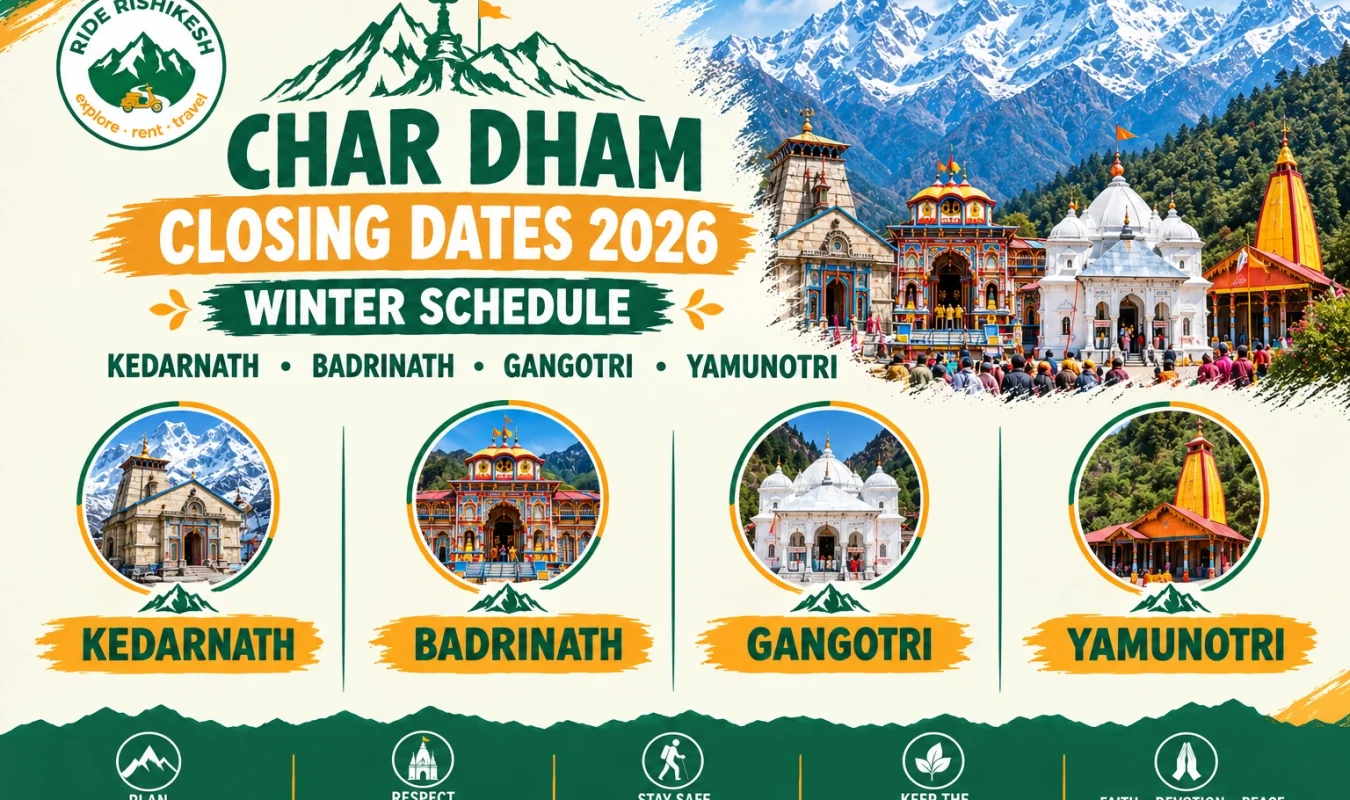

The Char Dham closing dates for 2026 fall between November 10 and 13 and if you’re planning to visit before the temples shut for winter, the window is shorter than most people realise. All four shrines close within four days of each other, timed to the Diwali festival period. This guide covers the exact closing dates for each temple, the Kapat Band (कपाट बंद) ceremonies, where the deities move for winter, the registration and helicopter booking process, and the best travel window before snowfall makes access difficult.
Char Dham 2026 Closing Dates : All Four Temples at a Glance
| Temple | Closing Date 2026 | Festival/Occasion | Winter Seat |
|---|---|---|---|
| Gangotri | 10 November 2026 | Govardhan Puja (day after Diwali) | Mukhba village, Uttarkashi |
| Yamunotri | 11 November 2026 | Bhai Dooj | Kharsali village, Uttarkashi |
| Kedarnath | 11 November 2026 | Bhai Dooj | Omkareshwar Temple, Ukhimath |
| Badrinath | 13 November 2026 (tentative) | 2 weeks after Diwali | Narsingh Temple, Joshimath |
These dates are announced officially by the respective temple committees and can shift by a day or two depending on the lunar calendar and auspicious timings. The dates above reflect the confirmed or widely reported 2026 schedule verify with the official Uttarakhand tourism portal or the temple Samitis closer to your travel date.
What “closing” means in practice: After Kapat Band, the temples are closed to pilgrims entirely. The deity idols are moved to their winter seats in lower-altitude villages where they remain until the following year’s opening (typically April–May). Only the priests accompany the deity to the winter seat; the high-altitude temples remain under snow for five to six months.
The Kapat Band Ceremonies : What Happens at Each Temple
Each closing is a formal religious ceremony, not simply locking a door. Understanding what happens helps you decide whether you want to be present for the ceremony itself or arrive before the crowds peak in early November.
Gangotri : November 10, 2026 (Govardhan Puja)
Gangotri’s closing falls on Govardhan Puja, the day after Diwali. The Gangotri temple is at 3,415m in Uttarkashi district, 248 km from Rishikesh. After the closing ceremony, Goddess Ganga’s idol is moved in a ceremonial procession to Mukhba village (also known as Gangotri’s winter home), about 10 km from Harsil. The winter seat functions as a regular accessible temple during the off-season.
Yamunotri : November 11, 2026 (Bhai Dooj)
Yamunotri, at 3,293m, closes on Bhai Dooj. The deity moves to Kharsali village (also called Janki Chatti), roughly 7 km from the Yamunotri temple complex. The closing ceremony at Yamunotri is a significant event if you’re visiting specifically for Bhai Dooj, arrive the previous day to find accommodation; November 10 and 11 draw large crowds.
Kedarnath : November 11, 2026 (Bhai Dooj)
Kedarnath (3,583m) closes on the same day as Yamunotri. The Panchmukhi idol of Lord Shiva is moved in a procession to Omkareshwar Temple in Ukhimath, Rudraprayag district about 41 km from Kedarnath by road. This procession is one of the most elaborate of the four Kapat Band ceremonies; thousands of devotees gather at Ukhimath to receive the deity.
The road from Sonprayag to Gaurikund (the last motor road point before Kedarnath) and the 16 km trek to the temple become snowbound after the closing. If you’re visiting in late October or early November, check road conditions at Sonprayag before proceeding.
Badrinath : November 13, 2026 (Tentative)
Badrinath (3,300m) closes approximately two weeks after Diwali each year, the 2026 date of November 13 is widely reported but subject to the official announcement from the Badrinath-Kedarnath Temple Committee. After closing, Lord Badri Vishal’s idol is moved to Narsingh Temple in Joshimath (1,890m), where it can be visited throughout the winter. The Badrinath closing ceremony includes the lighting of an Akhand Jyoti (eternal lamp) that burns throughout the winter season.
Last Chance to Visit : Best Travel Window Before Closing
If you’re planning to visit before the 2026 Char Dham closing dates, here’s the honest advice on timing.
September to mid-October 2026 is the best window. Post-monsoon clarity means the mountain roads are clear, the skies have opened up, and the peak summer crowds (May–June) have gone. The temples are open, the helicopter services are running, and you have the best chance of stable weather for the full circuit.
Late October to early November is viable but comes with increasing risk. Early snowfall can close the Kedarnath trek route and the Badrinath–Mana road with little warning. The Gangotri–Uttarkashi road has historically seen landslide activity into October after late monsoon rain. If you’re planning a late-season visit, build a 1–2 day weather buffer into your itinerary and check BRO road status every morning.
The week before closing (November 5–11) draws large crowds specifically because people know it’s the last chance. Accommodation at Kedarnath, Badrinath, and Gangotri fills up book everything 3–4 weeks in advance if you’re targeting the closing ceremony period.
Practical note on ATMs and fuel: There are no ATMs near Kedarnath temple (last reliable ATM at Rudraprayag or Sonprayag). Badrinath has limited ATM access — carry sufficient cash from Joshimath. Fuel is your responsibility on the drive; the last petrol pump before Kedarnath is at Tilwara or Sonprayag, and before Badrinath at Joshimath. Don’t rely on what you read online pump availability can change seasonally.
From Rishikesh, the Char Dham route branches at Devprayag Kedarnath and Badrinath go left (via Rudraprayag and Chamoli), Gangotri and Yamunotri go right (via Chamba and Barkot). If you’re arranging transport from Rishikesh for the Char Dham circuit, we’ll be offering dedicated taxi drops to all four dhams message us on WhatsApp with your dates and we can check availability.
Char Dham 2026 Registration and Helicopter Booking
Mandatory Registration
Registration for Char Dham Yatra 2026 is mandatory and free. Without a valid registration, you will not be permitted beyond checkposts near each temple.
How to register:
- Online portal: registrationandtouristcare.uk.gov.in
- Mobile app: Tourist Care Uttarakhand (available on Android and iOS)
- Offline: registration counters at Rishikesh, Haridwar, and key checkpoints on the yatra route
What you need: Government-issued photo ID Aadhaar card, Voter ID, or Passport. The 2026 rules include biometric registration at checkposts and digital passes carry both a printed and digital copy of your registration.
2026 new rules: Stricter ID verification at checkposts, controlled daily entry numbers at Kedarnath and Badrinath in particular, and digital pass requirements have been introduced. Don’t assume last year’s registration process is unchanged check the official portal before travel.
Kedarnath Helicopter Booking
Helicopter service to Kedarnath is the fastest way to reach the temple — the 16 km trek from Gaurikund takes 6–8 hours one way; the helicopter takes 7 minutes from Phata/Sersi/Guptkashi helipads.
Booking portal: heliyatra.irctc.co.in (IRCTC HeliYatra)
Requirement: Valid Yatra Registration Number before booking
Availability: Helicopter seats sell out 2–3 weeks in advance in peak season (May–June) and during the closing period (October–November). Book as early as the portal allows cancellation is possible but refund timelines vary.
Helicopter services may be suspended on days with cloud cover, strong winds, or ATC restrictions. Build a buffer day at the base location (Phata or Sersi) in case of weather delays.
Plan Your Char Dham Trip from Rishikesh
Rishikesh is the most practical base for the Char Dham circuit all four dhams are accessible from here, and the route begins on the NH58/NH7 corridor that starts just north of town.
For local transport within Rishikesh while you finalise your Char Dham logistics, our Activa and Access 125 scooties are available from the Swargashram area at ₹500/day. For the Char Dham taxi service itself which we’re launching soon message us on WhatsApp with your dates, group size, and which dhams you’re covering. We’ll confirm what’s available.
Note: We've put this together from the best sources we could find, but things on the ground — exact Kapat Band dates, road conditions, and new rules — can change quickly. Always verify with official temple Samitis and the Uttarakhand tourism portal before making final plans.
Frequently Asked Questions
What are the Char Dham closing dates for 2026?
Gangotri closes on 10 November 2026 (Govardhan Puja), Yamunotri and Kedarnath close on 11 November 2026 (Bhai Dooj), and Badrinath closes tentatively on 13 November 2026 (approximately two weeks after Diwali). All dates are subject to official confirmation by the respective temple committees verify on the Uttarakhand Tourism portal or the temple Samiti websites closer to your visit.
Where do the Char Dham deities go in winter?
Each deity moves to a lower-altitude winter seat after the Kapat Band ceremony. Kedarnath’s Panchmukhi idol goes to Omkareshwar Temple in Ukhimath (Rudraprayag). Badrinath’s Lord Badri Vishal moves to Narsingh Temple in Joshimath (Chamoli). Gangotri’s Goddess Ganga goes to Mukhba village (Uttarkashi). Yamunotri’s deity moves to Kharsali village. All four winter seats are accessible to pilgrims throughout the off-season.
Is registration mandatory for Char Dham Yatra 2026?
Yes. Registration is mandatory, free, and required before you reach the checkposts near each temple. Register online at registrationandtouristcare.uk.gov.in or via the Tourist Care Uttarakhand app. Carry your government-issued photo ID (Aadhaar, Voter ID, or Passport) and both digital and printed copies of your registration certificate. The 2026 rules include biometric verification at checkposts.
How do I book a helicopter to Kedarnath in 2026?
Helicopter bookings for Kedarnath are made through the IRCTC HeliYatra portal at heliyatra.irctc.co.in. You need a valid Yatra Registration Number before booking. Helicopter services operate from helipads at Phata, Sersi, and Guptkashi. The flight takes approximately 7 minutes. Book 2–3 weeks in advance for October–November visits seats sell out quickly during the closing period.
What is the best time to visit Char Dham before the 2026 closing?
September to mid-October 2026 is the most reliable window post-monsoon roads are clear, weather is stable, and crowds are lower than the May–June peak season. Late October is possible but carries increasing risk of early snowfall on the Kedarnath trek and the Badrinath–Mana road. The week before closing (November 5–11) is busy and accommodation fills up book in advance if targeting the closing ceremony period.
What documents do I need for Char Dham Yatra 2026?
A government-issued photo ID (Aadhaar card, Voter ID, or Passport) is required for registration and checkpost verification. A valid Char Dham registration certificate (digital or printed) must be carried at all times on the route. For Kedarnath helicopter booking, your Yatra Registration Number is required at booking. Bring physical cash — ATM access is limited near the temples.
Can I visit Char Dham in November 2026 — is it safe?
Visiting in early November is possible if you go before the closing dates, but road conditions deteriorate significantly by late October. The Kedarnath route from Gaurikund becomes snowbound unpredictably. The Badrinath–Mana road and the Gangotri highway can see early snowfall or landslide activity. Check BRO road updates every morning on the official BRO app or local news sources before driving. Build at least one buffer day into any late-season itinerary.
What happens to Char Dham temples after closing?
After Kapat Band, the temples at high altitude are completely closed to the public. Heavy snowfall buries the access roads and trek routes. Only the priests who accompany the deity to the winter seat remain in the lower villages. The temples at altitude are not maintained or guarded in the standard sense during winter they remain sealed under snow until the following year’s opening ceremony (typically April–May 2027).
Are ATMs and petrol pumps available near the Char Dham temples?
ATM access is very limited near the temples. Carry sufficient cash from the last reliable town before the high-altitude sections — Rudraprayag or Sonprayag for Kedarnath, Joshimath for Badrinath, Uttarkashi for Gangotri and Yamunotri. For fuel, the last confirmed petrol pumps before Kedarnath are at Tilwara or Sonprayag, and before Badrinath at Joshimath. Don’t assume pumps listed online are operational — verify locally before your trip.
What are the 2026 new rules for Char Dham Yatra?
The 2026 Char Dham Yatra introduced biometric registration at checkposts, stricter government ID verification, digital pass requirements, and controlled daily entry numbers at Kedarnath and Badrinath. The free registration is mandatory even for same-day visits. Rules can be updated by the Uttarakhand government between the announcement date and the closing period — check the official portal (registrationandtouristcare.uk.gov.in) for the most current requirements before travelling.
